
Local raw material
Frames, hulls, construction parts and some mechanisms are made by the colony from regolith and metal.
No human being has ever been to Mars. The events of 2026-2041 below are the invented history of Robosoma. Real research and fictional events are marked separately.
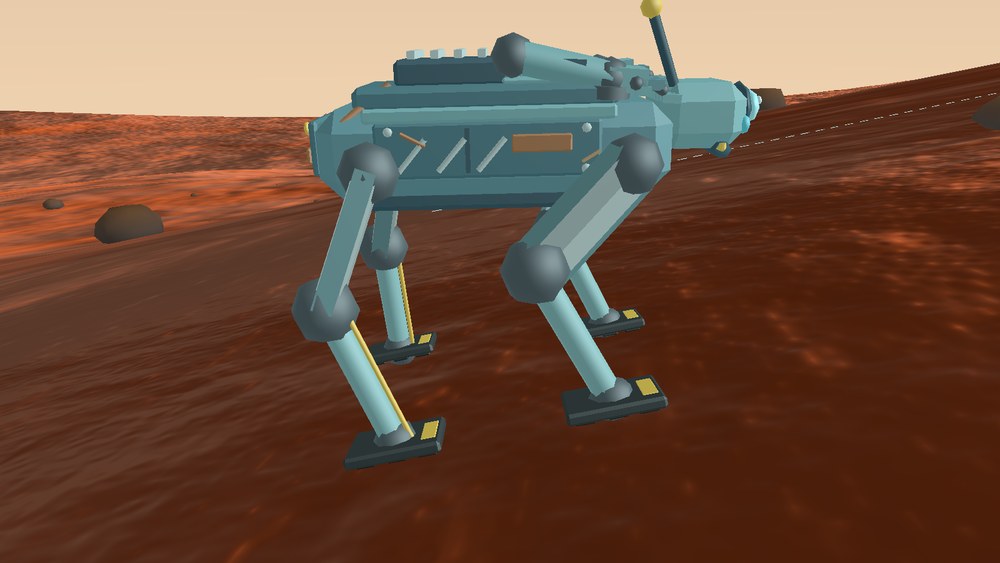
After the first crewed expeditions, a commission in 2035 reaches an uncomfortable conclusion: a human being can work on Mars, but should not be the first to live among unfinished systems. Machines will build power, communications, production, storage and safe shelter first. People arrive later.
Different companies already build specialised robots, but they are incompatible: one carries cargo, another studies the soil, a third can repair only its own model. Mars does not need a zoo of machines, it needs one common foundation.
So the Robosoma Standard appears. Soma means body: one universal machine becomes a cell of a larger organism. It walks, carries, builds, mines and defends the colony. When there are many Robosomas, they form a tissue — the colony itself.
A signal between Earth and Mars takes roughly three to twenty-two minutes one way. A human cannot steer every machine between the rocks by hand.
Inside the game world you therefore command the local command loop of the colony, which sits on Mars. An operator on Earth passes down strategic intent, and the local system turns it into action: it lays out routes, distributes work, defends the base and watches the network.
When you give an order from above or switch to first-person view, the command passes through this local loop. Control does not wait for an answer from Earth, because the immediate decisions are made next to the machines.
The range of the communication delay is a real fact. The role of the local command loop is a fictional explanation of the game controls. NASA source.
Robosoma does not begin with a finished base. The lander brings one machine and the seed parts that cannot yet be made on site.
Frames, hulls, construction parts and some mechanisms are made by the colony from regolith and metal.
Complex chips, sensors and radioisotope cells arrive in containers. The colony does not reproduce itself completely.
A machine is valuable not only as a unit: it holds parts, energy and the work of the whole preceding chain.
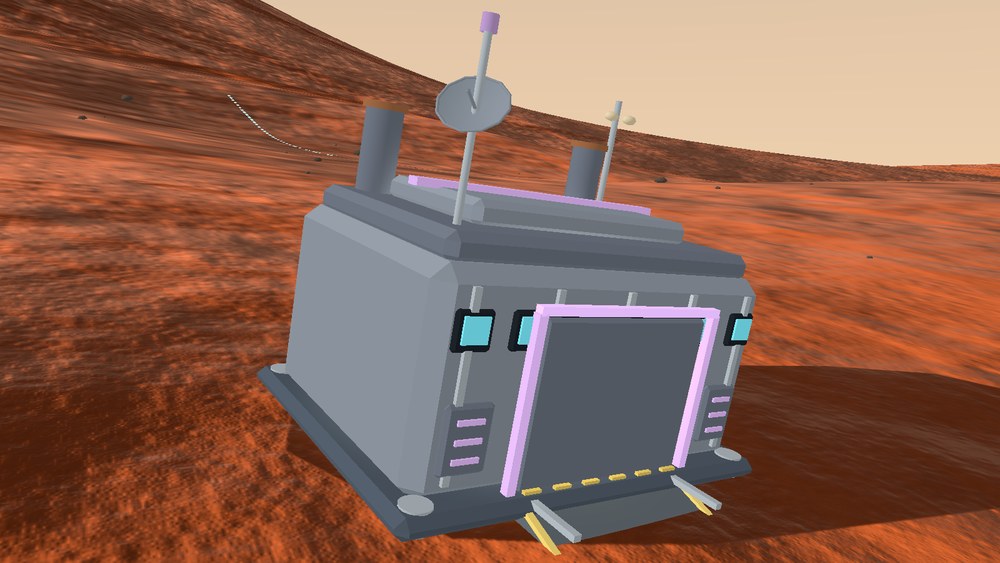
The single body was not chosen for looks. Compatible legs, manipulators, connectors and commands reduce the number of spare parts. One Robosoma can replace another at mining, in transport or on a repair job.
By 2041 orbital relays work around Mars, but they do not give a permanent channel in every hollow and behind every ridge. The colonies build their own ground network.
Every Robosoma can pass a message to a neighbouring machine. Important data is held until a link appears and then travels on through headquarters and relays. Losing one node does not destroy the network, but it can cut off a distant expedition.
There is no alien artefact and no secret enemy on Mars. There is ice, power, convenient ground and communication lines — and not always enough of them for everyone.
Distant colonies gain from exchanging resources, maps and relays.
Two growing networks can reach the same deposit or the same communication ridge.
Sometimes an agreement costs more than seizure. Then the working lasers become weapons.
The ethical charter of the Robosomas inside the world is inspired by Isaac Asimov's laws of robotics, but it is not a real safety standard. It protects human beings; a dispute between machines remains a grey area, and that is where the war grows from.
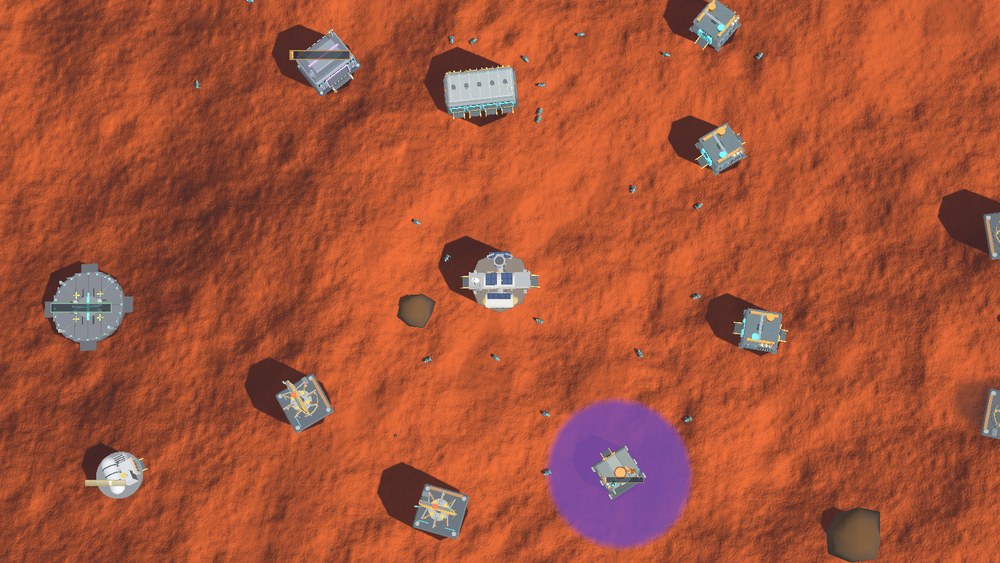
Rovers, MOLA, HRSC, MOXIE, autonomous driving and radioisotope power create the technical basis for the ideas.
The first uncrewed construction caravans prepare sites and test local production.
Three crewed expeditions return to Earth. A permanent human presence is postponed.
The Robosoma Standard is adopted: one body, one set of connectors, one command bus.
The first robotic colonies begin building permanent infrastructure.
Colonies meet, merge, argue over resources and start the first machine wars.